

Introduction: Why Hemingway Still Matters in 2026
Ernest Hemingway was an American novelist and short story writer. He developed a short, clear style that changed the way people write.

Citation: Britannica He first learned to write this way as a young journalist. Citation: Florida Division of Arts His stories also come from his real life. He served in World War I. He lived in Paris among other writers of the Lost Generation. Citation: Hofstra PDF He fished off the coast of Cuba and reported on wars in Spain. Citation: Hemingway Birthplace This exact mix of adventure and simple words is why his books feel fresh even today. Citation: Wikipedia
He won the Nobel Prize for Literature. Yet his writing never feels fancy. It feels real. That is a rare thing.
But here is the reality. If you usually read modern page turners or deep fantasy worlds, picking up a classic can feel like a chore.

You might look at lists like the New York Times top 100 books and feel lost. Or maybe you stick to novels by black authors or legal thrillers like john grisham books. That is fine. The hard part is knowing which old book fits your mood right now.
If you normally lean toward speculative worlds, stepping into literary fiction is not a huge leap. Great stories connect across genres. If you want to see how different styles overlap, check out our guide on modern fiction for genre readers.
This guide is here to help you find your way into ernest hemingway books. We will walk through his major works. We will talk about why his distinct style works so well. And we will show you why these stories still deserve a spot on your shelf in 2026. No pressure. No homework. Just great reading.
The Literary Giant: Who Was Ernest Hemingway?
So who exactly was the man behind these ernest hemingway books? To understand his stories, it helps to know the life he lived. And he lived a lot.
Ernest Miller Hemingway grew up in Oak Park, Illinois, a quiet suburb of Chicago. His father was a doctor, and his mother was a musician. But Hemingway did not stay in the suburbs for long. Right after high school, he skipped college and started working as a reporter for the Kansas City Star. Citation: Britannica
That job changed him forever. Newspapers taught him to write short, clear sentences. No extra words. No fancy descriptions. Just the facts. That style stuck with him for the rest of his life. Citation: Florida Division of Arts
Then World War I broke out. Hemingway wanted to see the action. He volunteered as an ambulance driver for the Red Cross in Italy. That experience was brutal. He was badly injured by mortar fire. But it also gave him material he would use in his most famous novels. Citation: Hemingway Birthplace
After the war, he moved to Paris. There he joined a group of American and British writers known as the Lost Generation. Citation: Hofstra PDF Think of it as a real life writers club. He spent time with famous names like Gertrude Stein and F. Scott Fitzgerald. Stein became a mentor and taught him to strip his prose down to the bone. Fitzgerald became a friend and a rival. This circle pushed him to find his own voice.
Hemingway also built a public image as a tough guy. He was a big game hunter. A deep sea fisherman. A war correspondent. He drank hard and fought harder. Citation: Wikipedia That persona made him a celebrity. But it was not the full picture.
The real Hemingway was a sensitive artist who worked incredibly hard on every sentence. He rewrote pages over and over to get them exactly right.

His rough exterior was partly a shield. Behind the macho act was a man who deeply understood loss, fear, and the quiet strength it takes to keep going.
Understanding this mix of toughness and emotion is the key to reading his work. Just like our guide on Charles Dickens books for fantasy and sci-fi readers shows, knowing the author’s life can unlock the stories. Hemingway’s life is not separate from his books. It is written into every scene.
Essential Hemingway: The Must-Read Books
If you have never picked up one of the ernest hemingway books before, you might wonder where to start. The good news is that Hemingway wrote only a handful of novels, and each one offers something different.
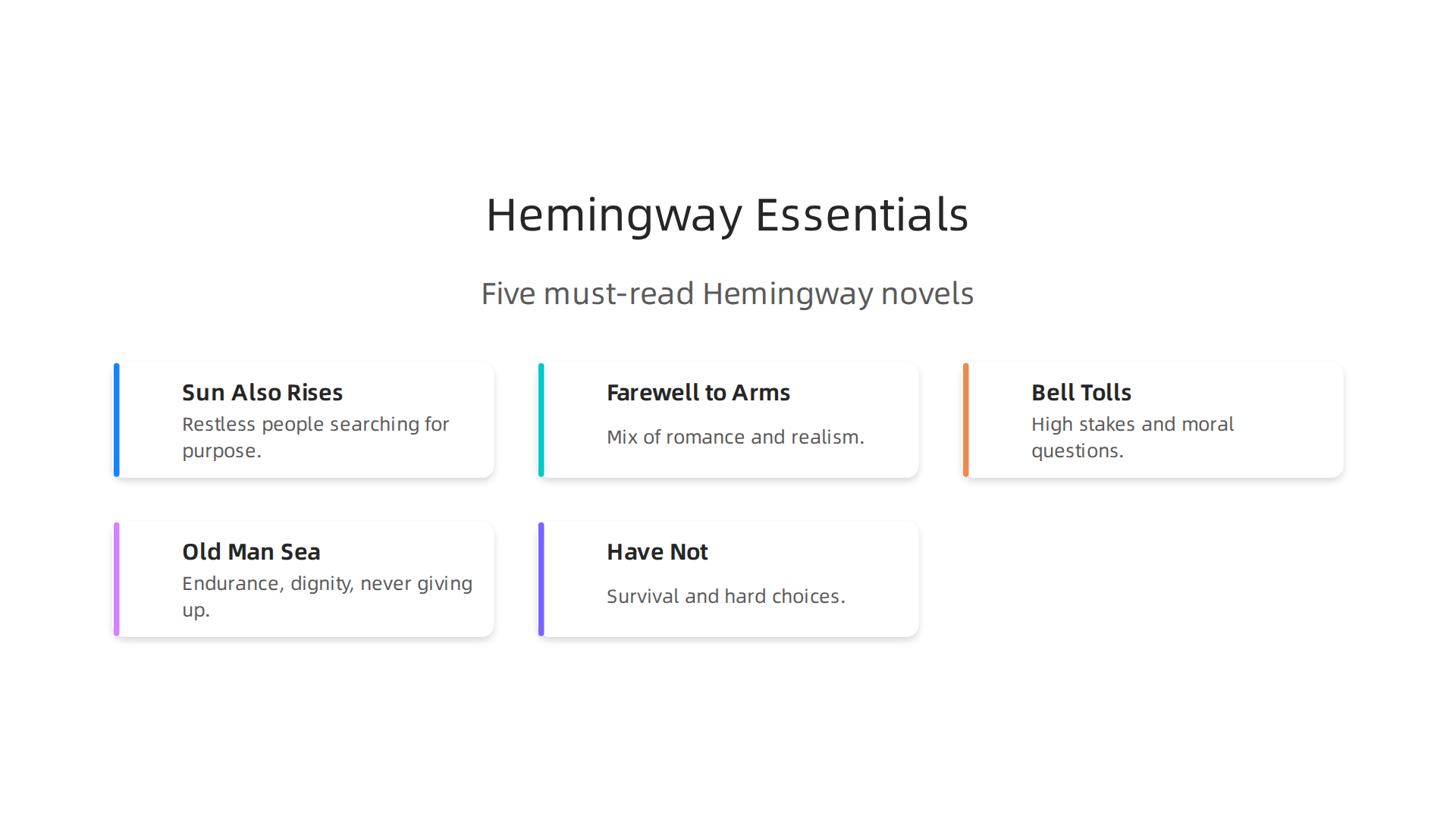
Here are the five most celebrated ones and what makes each special.
The Sun Also Rises (1926)
This was Hemingway’s first major novel. It follows a group of American and British expats who travel from Paris to the bullfighting festivals in Pamplona, Spain.
The characters drink, talk, and try to find meaning after the trauma of World War I. This book defined the Lost Generation. If you want a story about restless people searching for purpose, start here. Cite: Best Ernest Hemingway Books Complete Guide 2026
A Farewell to Arms (1929)
This is a wartime love story set in Italy during World War I. The main character, Frederic Henry, is an American ambulance driver who falls in love with a British nurse named Catherine Barkley. The book shows the brutality of war and the fragile comfort of love. Hemingway drew directly from his own experience as a wounded ambulance driver. This novel is perfect if you want a mix of romance and realism.
For Whom the Bell Tolls (1940)
Set during the Spanish Civil War, this novel follows Robert Jordan, an American dynamiter who joins a guerrilla group behind enemy lines. The story covers just three days, but it explores big ideas like duty, sacrifice, and the cost of fighting for what you believe in. Hemingway considered this his best work. If you enjoy high stakes and moral questions, this one is for you.
The Old Man and the Sea (1952)
This short novel won Hemingway the Pulitzer Prize and helped him earn the Nobel Prize in Literature in 1954. The Nobel committee praised him "for his mastery of the art of narrative." Cite: JFK Library The story is simple: an old fisherman named Santiago battles a giant marlin in the Gulf Stream. But beneath the surface, it is a story about endurance, dignity, and never giving up. This is the shortest and most accessible Hemingway book on this list. It is a great starting point.
To Have and Have Not (1937)
This novel is different from the others. It follows Harry Morgan, a boat captain in Key West and Cuba who turns to smuggling to support his family during the Great Depression. The book is darker and more cynical than Hemingway’s other novels. It shows what happens when a good man is pushed to the edge. If you like stories about survival and hard choices, this will grab you.
So which one should you read first? If you want a quick read, start with The Old Man and the Sea. If you want romance and war, go with A Farewell to Arms. If you want a classic story about lost souls, pick The Sun Also Rises. Each book offers a different doorway into Hemingway’s world.
And once you finish one, you will see why these novels still show up on modern book club lists today. They are built for discussion. If you are looking for more titles to spark conversation in your group, check out our guide on fantasy and sci-fi book club books that spark real discussion. Hemingway would have approved of a good argument about his books.
The Sun Also Rises – A Deep Dive
Among all the ernest hemingway books, The Sun Also Rises is the one that truly started everything. We touched on it in the list above, but this novel deserves a closer look if you want to understand what Hemingway was all about.
The story follows Jake Barnes, an American journalist living in Paris after World War I. He is in love with Lady Brett Ashley. She is beautiful, wild, and completely unavailable. Brett drifts between men while Jake watches, unable to fully have her. This might sound like a simple love triangle, but it is so much more. The two leave Paris with a group of friends and head to Pamplona, Spain, for the running of the bulls and the bullfights. What happens there feels less like a traditional plot and more like a slow fall into hard truths.
The real power of the book lies in what Hemingway does not say. He hides the big emotions beneath simple, flat sentences. This is his famous iceberg theory. The symbols he uses carry all the weight. The bullfight is the most important symbol in the novel. The bulls stand for passion, danger, and raw physical freedom Shmoop. But the story also uses the bullring to mirror the fights happening between the characters themselves SparkNotes. When the young matador Pedro Romero fights the bull, he is in total control. He is whole and purposeful. Jake and Brett can only watch from the crowd. They are separated from true passion by Jake’s war wound and Brett’s own choices. It is a brutal way to show what the Lost Generation had lost and a perfect example of how Hemingway uses violence and grace to explore sex, masculinity, and failure GradesFixer.
This novel defined a generation in 1926, and it still speaks to us in 2026. The search for purpose and the struggle with emotional scars never get old. If you enjoy books that use deep setting and symbolism to explore character, this one is a must read.
And if you want to see how modern authors use similar literary depth in genre fiction, take a look at our guide to modern crossover novels of 2026 for genre readers. These titles carry that same emotional weight but build entire worlds of fantasy and sci-fi around it.
Key Characters and Symbols
Jake Barnes is no typical hero. A war wound has left him impotent. This makes him a powerful symbol of masculine crisis.
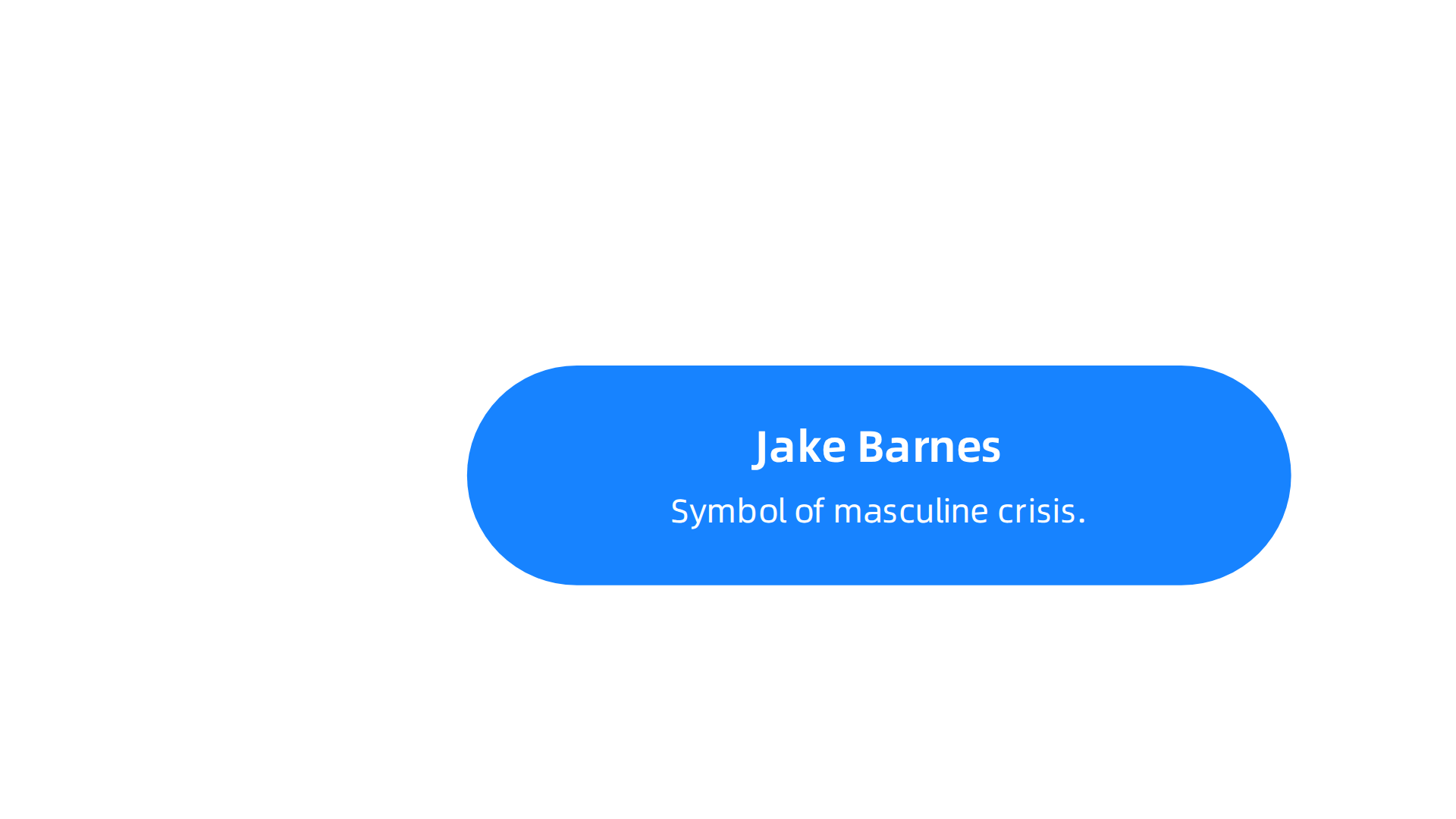
He cannot be with the woman he loves, Brett Ashley. So he watches her drift between other men while he stays stuck in place.
Brett is the "new woman" of the 1920s. She cuts her hair short, drinks heavily, and chases passion. But she is just as lost as Jake. She loves him but knows they can never be together. She keeps trying to fill a hole that nothing can fill.
The bullfighting motif ties it all together. The bulls stand for passion and raw physical freedom Shmoop. The young matador controls death with total grace. Jake and Brett can only watch from the crowd. Hemingway mirrors the fighting in the ring with the fighting between the characters SparkNotes. Every violent moment on the sand echoes the pain in their lives GradesFixer.
These symbols make The Sun Also Rises one of the most powerful ernest hemingway books. If you love stories built on intense emotional conflict, you will find similar depth in modern fantasy and sci-fi. Browse our list of heated rivalry books in fantasy and sci-fi for readers who crave intense conflict.
For Whom the Bell Tolls – A Masterpiece of War Literature
Now let’s shift from the emotional bullrings of Pamplona to the mountains of Spain. In For Whom the Bell Tolls, Hemingway trades bullfighting for real warfare. He takes what he learned about human pain in The Sun Also Rises and drops it into the Spanish Civil War. The result is one of the most gripping ernest hemingway books ever written.
The story follows Robert Jordan, an American explosives expert. He is behind enemy lines with a mission to blow up a bridge. The setting is brutal. The mountains are cold. The guerrillas fighting alongside him are tired and scared. Jordan knows he might die. But he stays focused on his duty. Hemingway shows us a man caught between his orders and his heart.

One of the biggest themes here is sacrifice. Jordan is not fighting for glory. He fights because he believes in something bigger than himself. Yet he also falls in love with Maria, a young woman who survived terrible violence. Their love story is tender and raw. It reminds us that even in war, people still reach for connection. Hemingway makes you feel the weight of every choice Jordan makes.
Hemingway’s writing style shines in this novel. He uses interior monologue to let you hear Jordan’s thoughts. You get the quiet doubts, the memories, the fear. He also drops in Spanish words and phrases. This makes the setting feel real. And he switches between different characters’ points of view. You see the war through the eyes of the loyal Anselmo and the brutal Pablo. Each voice adds a new layer.
The power of Hemingway’s symbols is on full display here, just as it was in his earlier work SparkNotes. The bridge itself becomes a symbol of connection and destruction. The pine forest stands for life and isolation. The bullfighting motifs from his earlier novel echo here in the final violent stand Shmoop. Hemingway ties the personal to the historical in a way few writers ever manage.
If you enjoy stories that mix epic scale with deep emotional stakes, you will find the same intensity in historical epics. Check out our list of Ken Follett books for fantasy readers who crave epic scale for more sweeping tales.
This novel often lands on the new york times top 100 books list for good reason. It is a must-read for anyone exploring ernest hemingway books. And if you want to branch out, you can try john grisham books for high-stakes legal tension, or dive into novels by black authors for powerful voices on struggle and survival. Hemingway opened a door. Walk through it and see where the war takes you.
The Old Man and the Sea – Pulitzer and Nobel Triumph
From the mountains of Spain, Hemingway took us to a different kind of battlefield. The ocean. The Old Man and the Sea is quieter than For Whom the Bell Tolls. But do not let the quiet fool you. It is just as fierce. It is also the book that finally won him the highest honors in literature.
The story is simple. Santiago is an old Cuban fisherman. He has gone 84 days without a catch. People call him unlucky. But on the 85th day, he sails far into the Gulf Stream alone. He hooks a giant marlin. For two days and two nights, he holds on. His hands bleed. His body screams. But he refuses to let go. He fights with everything he has left.

Hemingway writes in his famous iceberg style here. The sentences are short. The descriptions are clear. But under the surface, there is a whole ocean of meaning. Santiago talks to himself. He thinks about baseball. He says, "I will show him what a man can do and what a man endures."
The SparkNotes guide on the symbols explains how the marlin represents nature’s grace and power. It is a worthy opponent. The sharks that attack later are the destructive forces of the world. They tear away at what Santiago earned. But they cannot take his dignity. The LitCharts analysis of the symbols shows how the lions on the beach represent his lost youth and his undying spirit. The sea itself stands for life. It is beautiful and cruel at the same time.
This short book changed Hemingway’s career forever. It won the Pulitzer Prize for Fiction in 1953. Then came the big one. In 1954, the Swedish Academy awarded him the Nobel Prize in Literature. As the JFK Library notes, they praised him "for his mastery of the art of narrative." Hemingway was too sick to travel to Stockholm. The American ambassador received the prize on his behalf, as the Nobel Prize Award Ceremony record shows. This single novel was a major reason he got the Nobel.
This novel often lands on the new york times top 100 books list for good reason. It is a must-read for anyone exploring ernest hemingway books. It shows "grace under pressure" better than almost any story ever written.
If you love stories about characters who face impossible odds with quiet courage, you will find the same emotional depth elsewhere. Check out our list of Kristin Hannah books for unforgettable characters fighting their own battles. Or look at our books like Michael Crichton for high-stakes tension that keeps you turning pages. Hemingway opened the door to a new kind of storytelling. Walk through it and see where the sea takes you.
The Iceberg Theory in Practice
So what makes The Old Man and the Sea feel so deep even though the story is so simple? That is Hemingway’s iceberg theory at work.
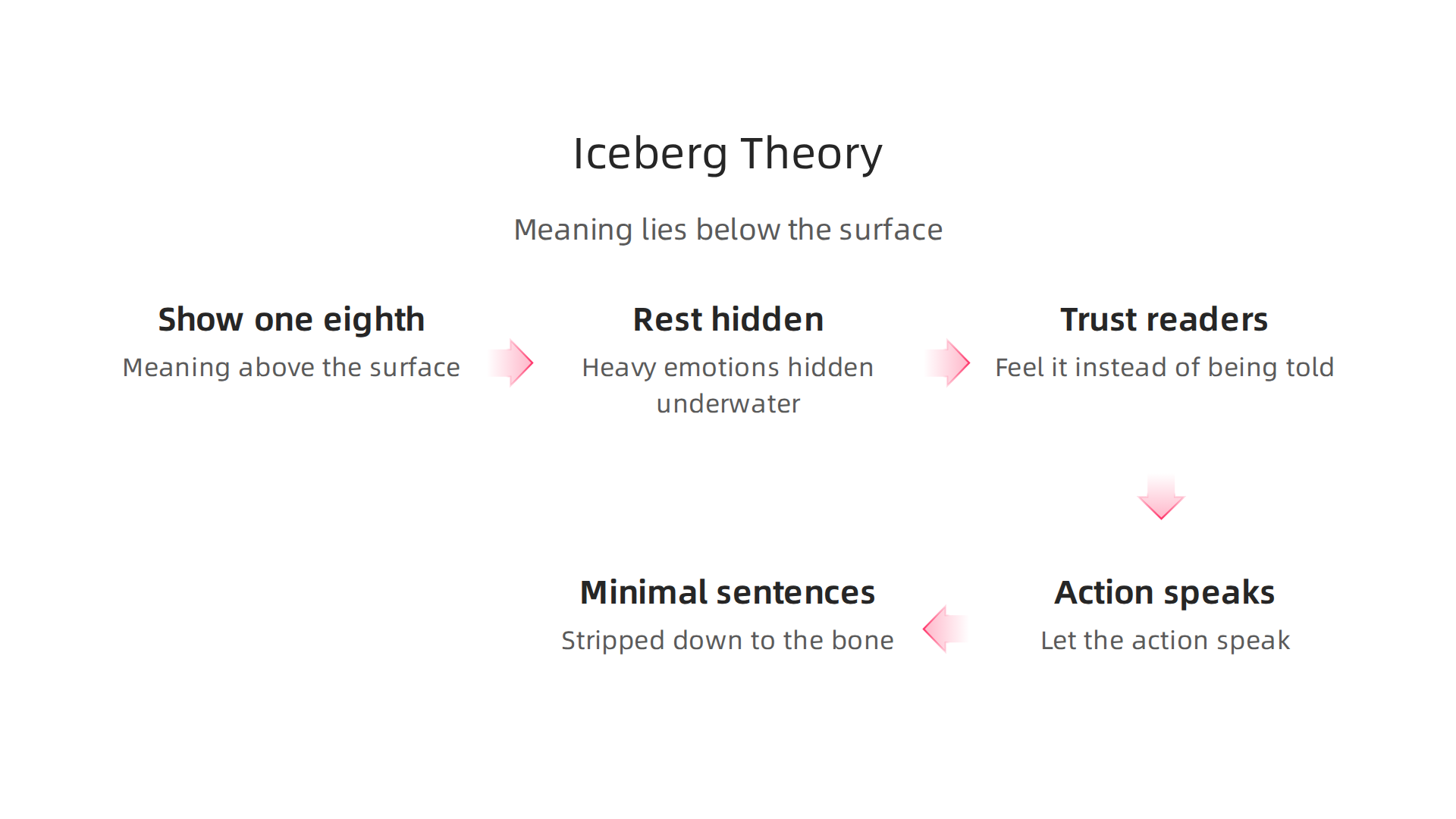
He believed a story should only show one eighth of its meaning above the surface. The rest, the heavy emotions and big themes, stays hidden underwater. The reader has to feel it instead of being told.
You see this everywhere in the novel. Santiago says almost nothing about his fear or his loneliness. He just holds the line until his hands bleed. The Writers Initiative explains that Hemingway stripped his sentences down to the bone. Yet under that plain surface, the Literative analysis of the symbolism shows how the marlin is not just a fish. It is a worthy opponent that represents nature’s grace and power. Santiago’s struggle becomes a fight for human dignity without ever saying that out loud.
This style was revolutionary in 2026 terms. It taught writers to trust readers. Instead of explaining every emotion, you let the action speak. The influence spread far beyond literary fiction. You can see that spare, tense prose in modern thrillers and even in many ernest hemingway books that followed. For a different take on tight storytelling, check out our list of modern fiction for genre readers that borrows from this same iceberg approach.
Hemingway’s Writing Style and Its Enduring Influence
You might wonder what makes Hemingway’s sentences so different from other writers. The answer lies in a few simple rules he followed.
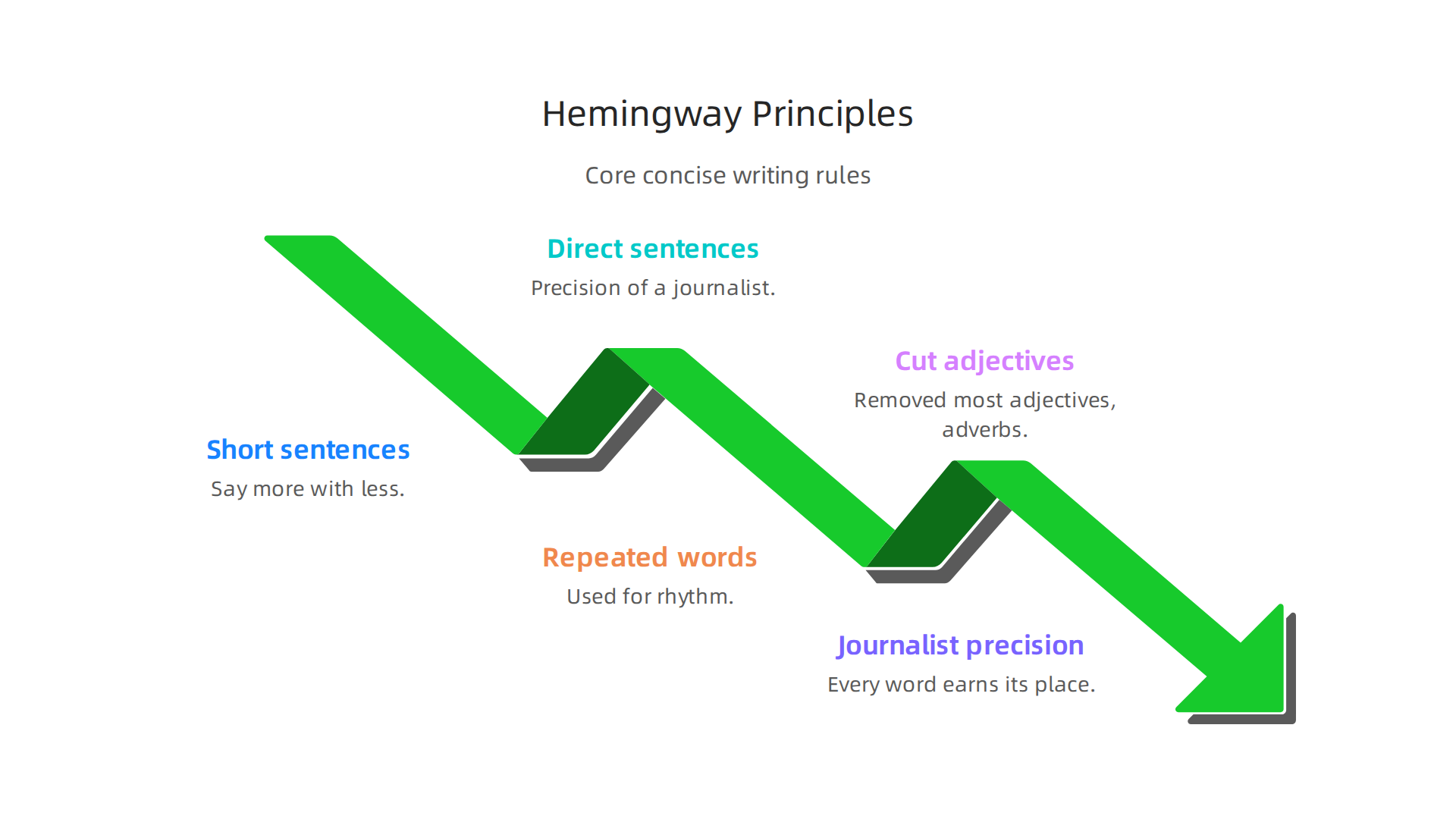
He used short, direct sentences. He repeated key words for rhythm. He cut most adjectives and adverbs. And he wrote with the precision of a journalist.
This approach came from his years as a newspaper reporter. He learned to say more with less. The Writers Initiative notes that Hemingway stripped his sentences down to their bones. He wanted every word to earn its place.
But here is the thing. His style is harder to pull off than it looks. Many writers try to copy it and fail. They end up sounding flat instead of powerful. The difference is what you leave unsaid. Hemingway trusted his readers to fill in the gaps.
Where you see his influence today
His impact on modern fiction is huge. You can spot it in authors like Raymond Carver, Cormac McCarthy, and Elmore Leonard. They all use spare, tough prose that lets the action speak for itself. The Shelf Talk article lists several writers in the Hemingway tradition, including Carver and Woolrich. Even modern thriller writers borrow his approach.
For a look at how this style works in current genre fiction, check out our guide to modern fiction for genre readers. It shows how authors today use tight storytelling to keep you hooked.
The critiques and the paradox
Not everyone loves Hemingway’s style. Some critics say it gets overdone. Too many writers try to sound tough and end up sounding cold. Others argue that his stripped-down prose misses emotional depth.
Literary Hub points out a paradox about Hemingway. He is known as a macho, masculine writer. Yet his work actually questions masculinity. That tension makes his writing more interesting than it first appears.
The real lesson from Hemingway is this. You do not have to say everything. Leave room for the reader to feel the weight. That is why his books still matter today, alongside authors from many traditions like the ones featured in the new york times top 100 books lists. His style is a tool, not a rulebook. Use it wisely.
The Debate: Minimalism vs. Richness
Not everyone loves Hemingway’s stripped-down style. Some readers find it flat or lacking the rich lyricism you see in other modernists. They miss the poetic flow that authors from different traditions bring.
But the argument for his approach is strong. Clarity, directness, and the power of understatement. The CliffsNotes essay on the Hemingway influence calls him the twentieth century’s most influential writer because he proved that less can hit harder.
How to appreciate his style today
Try reading The Old Man and the Sea or A Farewell to Arms. Then compare it to something like John Grisham books, which use a similar journalistic directness. Or explore novels by black authors that layer emotional richness onto tight prose.
The trick is not to choose one side. Appreciate Hemingway for what he does best. Then use his clarity as a lens to understand other voices. For deeper dives into modern storytelling that keeps the action tight, check out our guide to books that share Hemingway’s directness.
Summary
This guide introduces Ernest Hemingway for readers who may find classics intimidating and explains why his work still matters in 2026. It sketches Hemingway’s adventurous life—journalism, war service, Paris expatriate years—and shows how those experiences shaped his spare, direct style. The article walks through five essential novels (The Sun Also Rises, A Farewell to Arms, For Whom the Bell Tolls, To Have and Have Not, The Old Man and the Sea), explains key themes and symbols, and offers reading-entry points based on mood and interest. You’ll learn how Hemingway’s iceberg theory leaves much unsaid, why his prose influenced modern writers, and how to appreciate his strengths while recognizing common critiques. After reading, you’ll know which Hemingway book to start with and how to read his work for emotional depth rather than ornate language.